

Personal tax compliance has never had more technology behind it, and it has rarely felt more disjointed.
Client portals have made document collection easier. Extraction tools have cut down manual keying. Tax software has become genuinely sophisticated. Cloud has let teams work from almost anywhere. Judged feature by feature, the profession’s technology stack has never looked stronger.
And yet, walk the floor of almost any accountancy practice during Self Assessment season and you will find the same scene repeating itself, client after client: a P60 arriving through one portal, a rental statement landing by email, bank transactions sitting in a separate system entirely. Someone downloads the documents and collates the information before passing it to another person to check. The figures are then manually transferred into the tax software, often creating another touchpoint, while any questions or missing information are passed back to the client and handled again when they respond. Only after these repeated manual hand-offs can the return be completed and submitted to HMRC.
No single step in that chain looks like a problem, which is precisely what makes the pattern so easy to miss, and so expensive to ignore.
MTD removes the safety net of “once a year”
Making Tax Digital for Income Tax turns this from a seasonal irritation into a year-round structural problem.
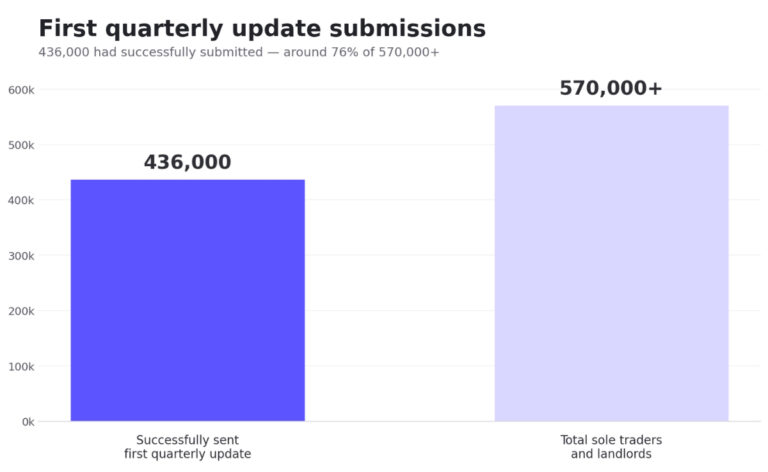
The scale of the change is not trivial. MTD for Income Tax became mandatory from April 2026 for sole traders and landlords with qualifying income above £50,000, with the first quarterly update deadline falling on 7 August 2026. By HMRC’s own figures, more than 436,000 sole traders and landlords had successfully sent that first quarterly update, out of over 570,000 who had signed up to the service. From September 2026, HMRC began signing up, in stages, the customers who should be using MTD but had not yet done so themselves – a clear signal that the population still catching up is significant. A second wave follows from April 2027, bringing taxpayers with qualifying income above £30,000 into scope and expanding the client base every practice will eventually have to service under the new regime.
HMRC’s own Director of Making Tax Digital, Craig Ogilvie, has struck an upbeat tone on early progress, noting that many customers have found the process straightforward once they were signed up. That optimism is worth reading carefully, though: it describes the experience of filing a quarterly update through compatible software – not the work a practice has already done behind the scenes to get clean, reconciled figures into that software in the first place. That upstream work is exactly where a fragmented workflow bites.
What changes isn’t just the paperwork. It’s the metabolism of the work. Instead of one annual push, firms must now collect, process and review client data on a quarterly cycle, with updates due every three months and a final declaration still landing every 31 January.
A workflow with unnecessary handoffs is tolerable when most of the friction happens once a year. Multiply that same friction by four, and the maths changes completely. A process that cost a firm a day of avoidable admin annually now costs four days – and that’s before accounting for the extra client queries, extra reconciliation, and extra chasing that a more frequent cycle inevitably brings.
This is why the MTD conversation cannot stop at “is our software compatible?” The sharper question is whether the whole personal tax workflow – not any one tool within it – can operate at four times the frequency without falling over.
Why buying another tool rarely fixes it
The accounting technology market has spent the last decade encouraging firms to solve individual problems with individual products: one app for document collection, another for extraction, another for bookkeeping, another for workflow, another for tax preparation, another for filing.
Many of these tools are excellent at the specific job they were built for. The damage happens in the gaps between them – the point where output from one system has to become input for the next.
That pattern is well documented beyond accountancy too. Industry-wide research on manual data entry puts the productivity loss from repetitive, cross-system admin at up to 27% of a knowledge worker’s time, and separate analysis of AP-style processing has found that well over half of total processing cost in document-heavy workflows sits in manual data entry and matching – not in the “core” task itself. A five-minute saving inside one application counts for little if someone then spends several minutes exporting, checking and re-entering that same information elsewhere. Automating a single stage cannot compensate for fragmentation across the whole journey.
That reframes the technology question practices should actually be asking. It isn’t “which extra tool would make this task faster?” It’s “how many tools does this task need to touch in the first place?”
From the client to HMRC: closing the gaps
This is the thinking behind ApariPro.
Rather than optimising one isolated stage of personal tax compliance, ApariPro connects the workflow end to end: from the moment information is collected from the client, through extraction, review and client approval, to the point the Self Assessment return or MTD update is submitted to HMRC.
Client documents and records enter the platform once. Relevant information is extracted and allocated automatically. The resulting data is prepared for the accountant to review (with professional judgement staying exactly where it belongs) at the centre of the process. What ApariPro removes isn’t the accountant’s oversight; it’s the administrative weight that has to be cleared before that oversight can be applied.
Crucially, these aren’t separate products stitched together with a shared login. They are stages of one continuous process designed so that information moves once, correctly, rather than being re-entered at every handoff.
The next efficiency gain sits between your systems
For years, the industry narrative around efficiency has been about making individual tasks faster: quicker extraction, quicker reconciliation, quicker filing. The next phase of that story is less about speed and more about subtraction – removing tasks, and the handoffs between them, altogether.
As personal tax becomes both more frequent and more digital, the practices that pull ahead won’t necessarily be the ones with the most software. They’ll be the ones that have actually mapped the journey a piece of client information takes through the firm, and asked some uncomfortable questions of it:
- How many times does the same piece of information get handled?
- How often does a person have to physically move it from one place to another?
- How many separate applications does a member of staff need to open before a client’s return reaches HMRC?
Those three questions will likely say more about a firm’s real capacity under MTD than any feature list ever could.
For ApariPro, “end to end” is meant literally: the journey starts with what the client sends and finishes with submission to HMRC, with preparation, review and approval connected in between.
In the next article in this series, we look at one of the most labour-intensive parts of that journey: what actually happens after a client sends a tax document.