

Every accountant already knows documents are a hassle to collect. What’s less visible is what happens after one arrives – and that’s usually where the real cost sits.
A P60 lands by email, a rental statement through a portal, a photo of a payslip from a phone. For the client, that’s the end of the task. Inside the practice, it’s often the start of one – and it’s a start most firms have never actually measured.
The touch count is higher than it feels
Ask most partners how many times a single document gets handled before it reaches a return, and the answer is usually a guess. In practice, that P60 gets downloaded, filed, opened, checked against other records, and its figures re-keyed into tax software, sometimes cross-checked again before the return is even started. Multiply that by every income type a client has: bank interest, dividends, pensions, rental income, capital gains – and the number of “touches” per client is typically far higher than anyone in the practice would estimate off the top of their head, precisely because no single person sees the whole chain. Each person only sees their own step.
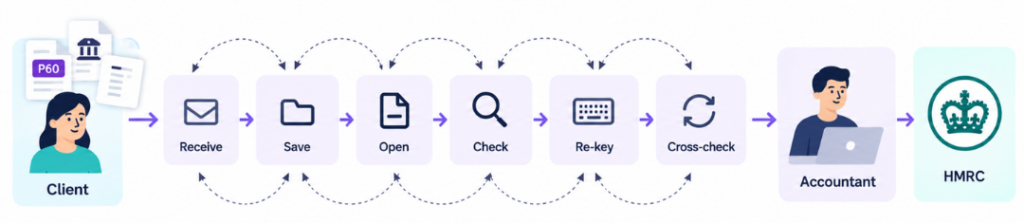
That’s the first blind spot: the workload isn’t hiding in any one task. It’s hiding in the accumulation of small, individually reasonable steps that nobody is tracking end to end.
Where the time actually goes
Most efficiency conversations focus on preparation; how fast the return itself gets built. But once the information is complete and correctly sitting in one place, preparation is often the quickest part of the job. The real time sits upstream, in getting the information into that state: identifying what’s arrived, chasing what hasn’t, and reconciling figures that come from three different sources.
Firms rarely account for this because it doesn’t show up as a discrete task on a timesheet. It’s distributed across dozens of small interruptions. A quick check here, a chase email there – none of which look significant enough to fix on their own.
The blind spot between systems
A portal, an extraction tool and tax software can each work exactly as designed and a firm can still be leaking hours, because nobody “owns” the space between them. Information gets exported from one system and manually reconciled before it’s imported into the next, and that reconciliation step is where errors quietly creep in: a figure entered against the wrong client, a document marked received when it’s still incomplete, a client chased for something they already sent.
These aren’t failures of any individual tool. They’re failures of visibility at the joins – and because no application is responsible for the handoff, no dashboard shows how often it goes wrong until the mistake surfaces much later, usually at review.
MTD turns invisible costs into recurring ones
This matters more now because Making Tax Digital for Income Tax repeats the annual cycle four times a year. HMRC has also been clear that the update itself is short: a summary, not a return, taking minutes through compatible software.
That’s the second blind spot. HMRC’s messaging describes the filing as fast, which can make a firm feel MTD-ready simply because its software connects. But filing speed says nothing about the hours spent getting information into a fileable state, and whatever that hidden cost is today, MTD doesn’t remove it. It simply brings that process into a quarterly rhythm. From April 2027, late quarterly updates will also begin attracting penalty points, with a £200 penalty once the relevant threshold is reached.
What visibility actually changes
The fix isn’t more automation at any single stage. The fix is being able to see the whole journey a piece of information takes: how many times it’s touched, where it sits when it’s incomplete, and which handoffs are quietly generating rework.
This is what ApariPro is built around. Not another tool bolted onto the process, but a way of connecting client information from collection through to HMRC submission so the journey itself becomes visible, not just each stage of it. Professional judgement stays exactly where it belongs; what changes is how much invisible work happens before that judgement is even needed.
A useful exercise for any firm: pick one client, and try to genuinely count how many times a single document was touched last year. Most partners are surprised by their own answer.
Next in this series: what “end to end” actually means, and why a connected workflow is different from simply adding more software.